Aurora Village vs Aurora Hunting Tours: Camp or Chase?
The real question behind this comparison is not one brand against another. It is two styles of aurora night: settling into a fixed camp, or chasing clear sky by van. Both work. They suit different people.
 Written with Thomas Beaulieu, Yellowknife tour guide & northern lights specialist
Short answer
Aurora Village is a well-known local operator with a fixed teepee camp off the Ingraham Trail; we do not sell it. A fixed camp gives you warmth, atmosphere and infrastructure in one place. A mobile hunt can drive out from under cloud, runs smaller groups, and on the flagship 4.8-rated tour includes hotel pickup and free photos. Cloud tolerance is the honest tiebreaker.
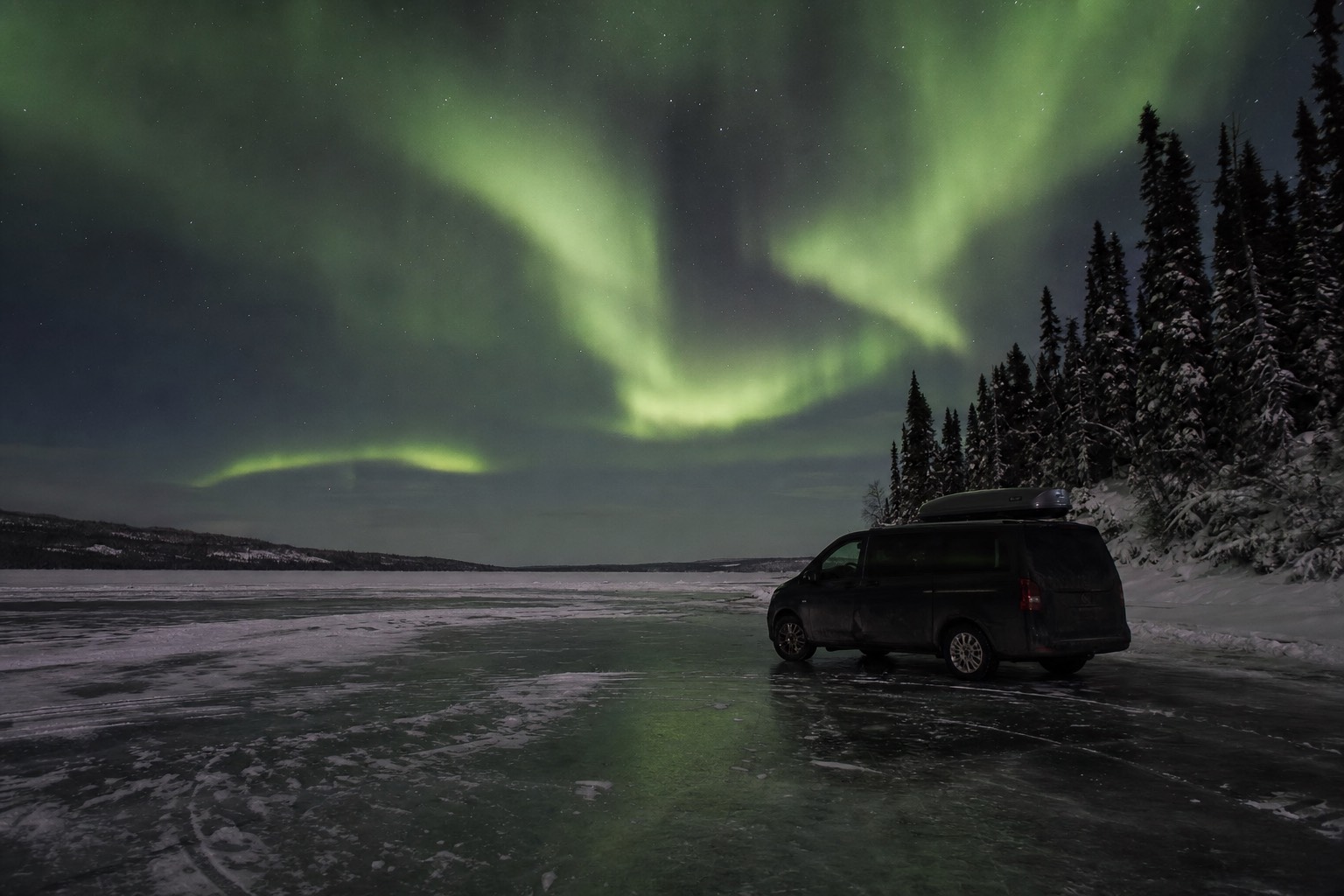
Some nights on the Ingraham Trail I drive past the turnoff where the teepee glow sits warm against the trees, my van full of guests headed further out to a lakeshore I picked an hour earlier off the cloud map. Both vehicles are full of people about to have a good night. That is the truth of this comparison, and it is worth saying before any table: Yellowknife's aurora scene is not a war between operators. It is a choice between two styles of night, and picking the right style for you matters more than any brand name.
Is Aurora Village or an aurora hunting tour better for seeing the lights?
Neither style is objectively better; they optimize for different things. A fixed camp like Aurora Village gives you built infrastructure, heated teepees and atmosphere at one prepared site. A mobile hunt trades the campfire comfort for freedom of movement: small groups in a van that drives to wherever the sky is clearest tonight.
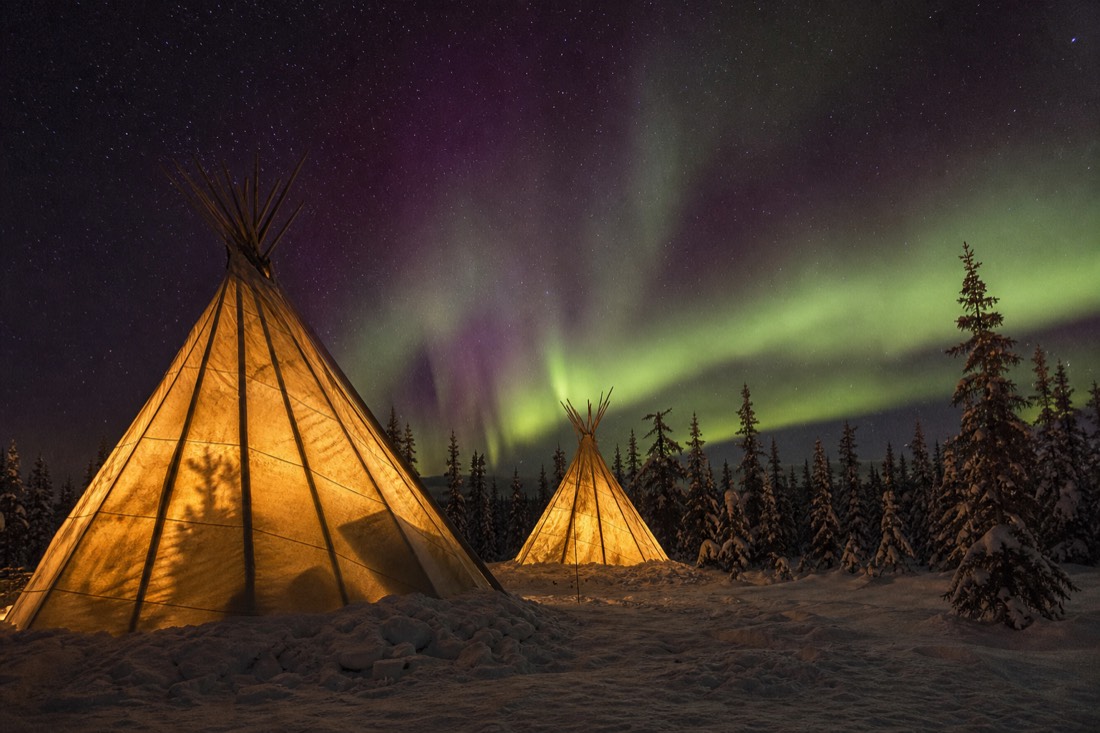
Let me be plain about my position first. I guide hunts, this site features hunting and lodge tours, and we do not sell Aurora Village. So take my leanings for what they are, and take the facts straight. Aurora Village is a major, well-known local operator, and its fixed teepee camp off the Ingraham Trail is one of the most recognized aurora experiences in the Northwest Territories. People love it for real reasons. I am not here to talk you out of it, only to explain what each format actually does when the sky starts moving, or refuses to.
The good news underneath the whole choice: geography does the heavy lifting here either way. Yellowknife sits directly under the auroral oval, with aurora visible up to 240 nights a year and a 98% chance over three nights in season. Low activity is enough for a show. Whichever format you pick, you picked the right city.
What does a fixed aurora camp do well?
Infrastructure, mainly, and that is no small thing at -25C. A fixed camp is built in advance: heated shelters, hot drinks, room for large groups, and an atmosphere you cannot assemble from a van. You walk out of the warmth when the sky lights up and back in when your toes complain.
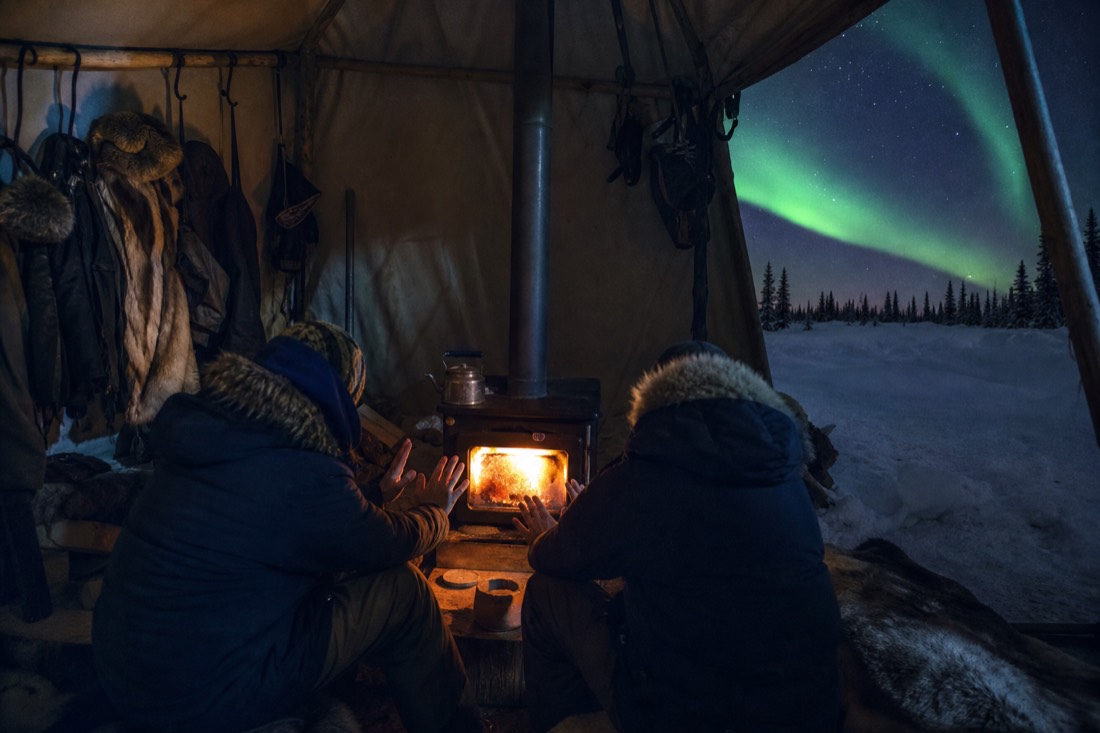
Camps solve the two problems that ruin aurora nights for unprepared people: cold and boredom. Waiting is most of aurora watching. The lights build near local midnight, and the hours before can be quiet sky. A fixed site fills that waiting with warmth and something to do, and the teepee-against-the-stars scene is genuinely lovely. For travelers with kids, for anyone with limited mobility, or for people who simply hate sitting in vehicles, the case is obvious.
The structural limit is just as easy to state. A fixed camp is fixed. The sky you get is the sky above that one site, and the aurora does not check the booking calendar. Which brings us to the question that actually decides this comparison for most people.
What happens when it clouds over?
Cloud is the moment the two styles separate. At a fixed site, if cloud parks over the camp, you wait it out and hope for a gap. On a hunt, the driver checks the sky and satellite picture and simply leaves, sometimes an hour down the road, until the stars come back out.
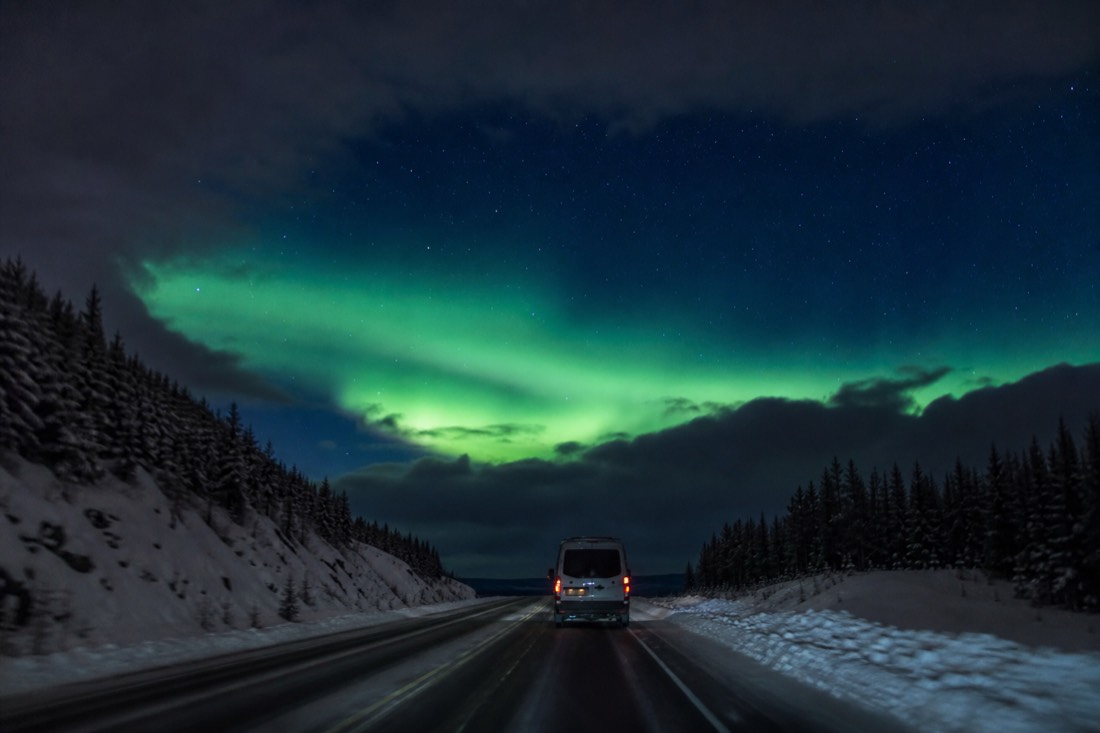
I have watched cloud sit stubbornly over one lake while the next lake up the trail was wide open. That is a normal Yellowknife night, and it is why the city's own aurora and weather page is one of my most-checked tabs in season. Here is the honest scenario table.
| Tonight's sky | Fixed camp | Mobile hunt |
|---|---|---|
| Clear everywhere | Great night; warm base under a working sky | Great night; first viewpoint is usually the keeper |
| Patchy, moving cloud | You wait for gaps over the site | Driver repositions between viewpoints ahead of the cloud |
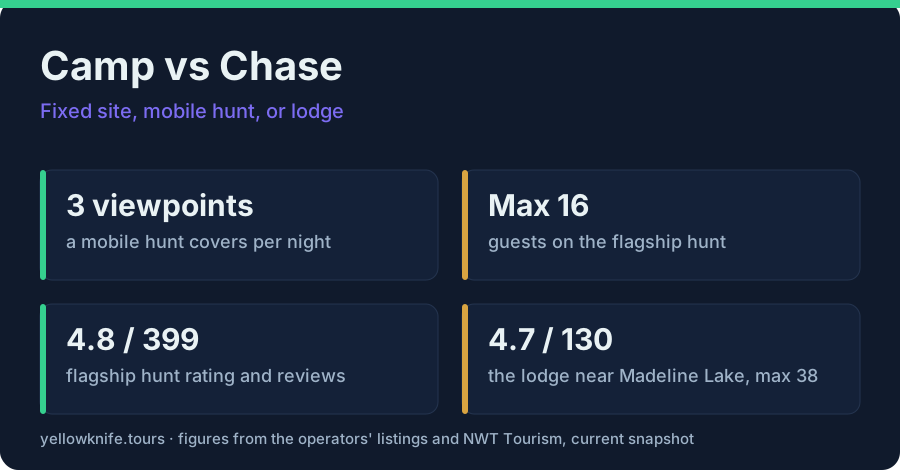
| Cloud parked over one area | Hope it lifts before closing time | Drive out from under it; the flagship route works three viewpoints a night |
| Socked in region-wide | Nobody wins; the camp is at least warm | Nobody wins; a long drive can still find a seam, no promises |
| Aurora low on the horizon early | Depends on the site's sightlines | Driver picks a flat lake horizon facing the arc |
Read the last row twice if you are coming in autumn, when displays often start low. And keep the honesty of row four: no format beats a fully overcast region. That is why every serious aurora plan here is built on three or more nights, the math I walk through in chances of seeing the northern lights in Yellowknife.
What does a mobile aurora hunt actually include?
On the flagship hunt: hotel pickup, a group capped at 16, four hours across three viewpoints, a photographer who shoots you under the aurora, free photos, and cookies with hot drinks in the van. It rates 4.8 across 399 Viator reviews and cancels free up to 24 hours out.
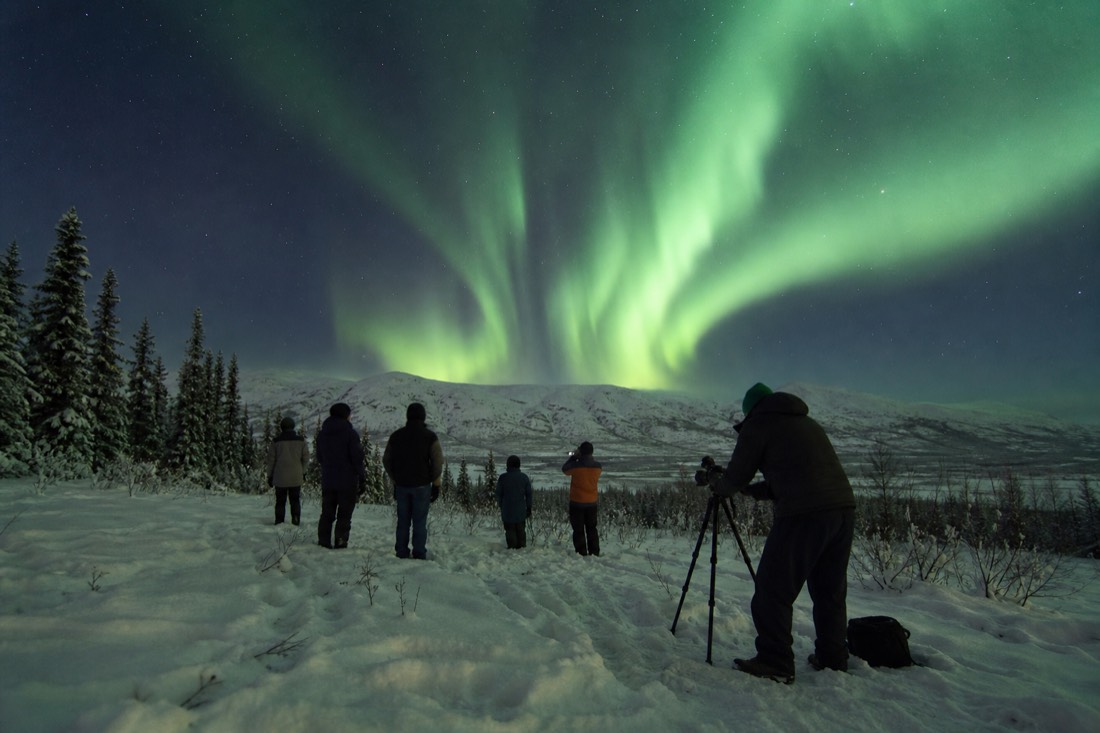
A hunt is a lighter machine than a camp, and that is its point. Pickup comes to your hotel between roughly 9:30 and 10:30pm, the van carries the warmth with you, and the itinerary is written by the sky, not the brochure. The photographer matters more than people expect: aurora photography defeats most phone cameras, and going home with real frames of yourself under the lights, included free, quietly beats most souvenirs. One review of this tour describes a good show on a night the forecast read Kp 0.0, which tells you what position under the oval is worth. I wrote up the hour-by-hour feel of one of these nights in what an aurora hunt is really like.
Compare all the formats on the northern lights tours page, or check live availability and prices for the flagship hunt on Viator before your dates go, because small-capacity tours are the first to sell out in peak weeks.
Is a lodge tour the middle path between camp and chase?
Yes, and it is the format I recommend to people torn between the two. The lodge tour bases you at a heated lodge near Madeline Lake, with games and WiFi for the waiting hours, but keeps a chase option when the sky demands it. It rates 4.7 across 130 reviews.
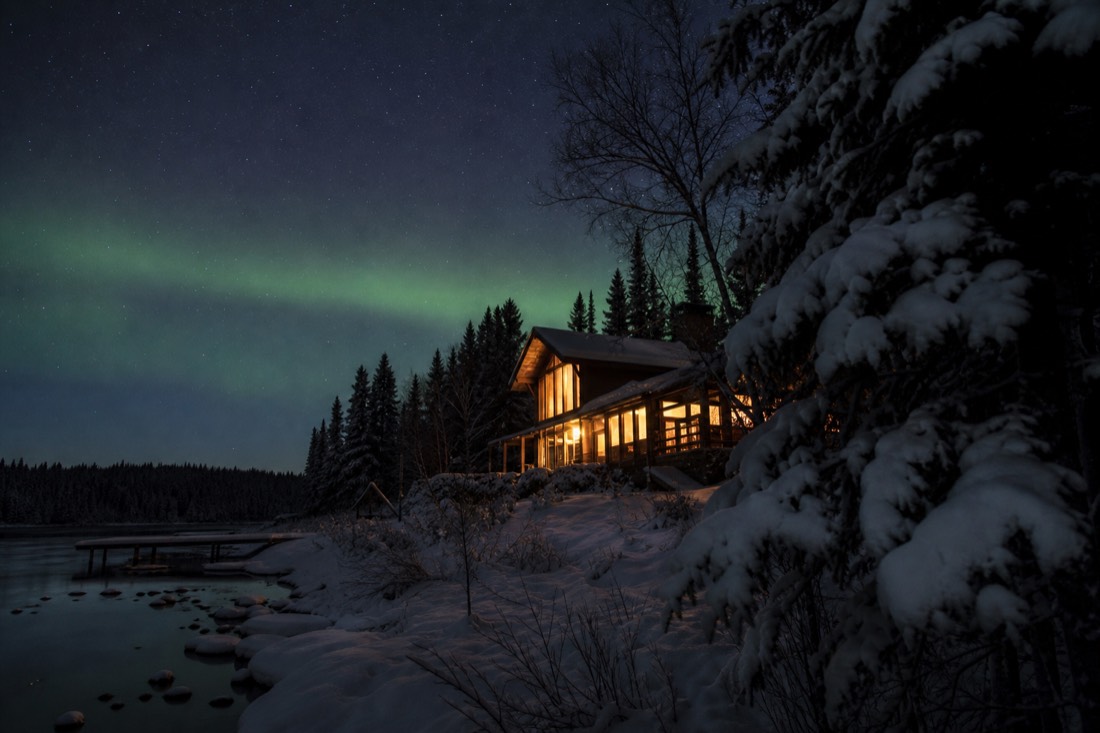
The lodge answers the camp's biggest weakness without giving up its biggest strength. You get a warm fixed base, an actual building with board games and hot drinks, and if cloud settles in, the chase option puts you back on the road instead of leaving you staring at grey. Groups run larger than the flagship hunt, up to 38, which is the trade for the roof. For travelers who want to go further still, the two-night cabin trip sleeps you out on the aurora's schedule entirely, in a cabin or glass tipi with transfers included. Here are the three side by side.
| Flagship hunt | Lodge tour | 2-night cabin | |
|---|---|---|---|
| Rating | 4.8 (399 reviews) | 4.7 (130 reviews) | 4.6 (7 reviews) |
| Format | 4 h mobile chase, 3 viewpoints | 4 h heated lodge near Madeline Lake, chase option | 2 nights, cabin or glass tipi |
| Group size | Max 16 | Max 38 | Small-group |
| Photos | Photographer, free photos | Photographer | 2 digital photos included |
| Pickup | Hotel pickup | Pickup included | Airport and hotel transfers |
| Cancellation | Free to 24 h | Free to 24 h | Free to 24 h |
Which style should you actually book?
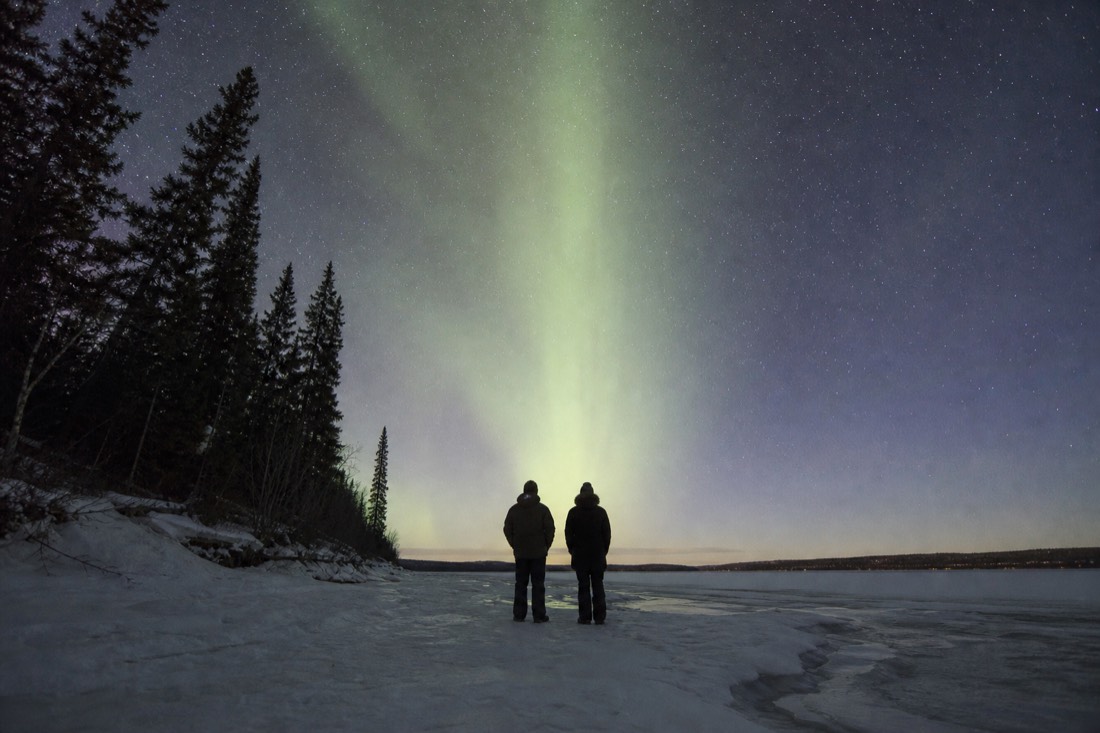
Book the camp style if warmth, atmosphere and ease top your list. Book the hunt if maximizing your odds against cloud matters most, or you want small groups and free photos. Book the lodge as the compromise. And whichever you choose, book early: everything here fills in peak season, Aurora Village included.
| You are... | Best style | Why |
|---|---|---|
| A family with young kids or limited mobility | Fixed camp | Warm base, no long stints in a van |
| A photographer or aurora-first traveler | Mobile hunt | Repositions for clear sky and clean flat horizons |
| Nervous about deep cold | Lodge | A real heated building with a chase option in reserve |
| On a tight schedule with only 1-2 nights | Mobile hunt | Cloud-dodging squeezes the most from few chances |
| Wanting the full northern-night immersion | 2-night cabin | You sleep where the show happens |
| Undecided with 3+ nights booked | Mix them | A camp or lodge night plus a hunt night covers both skies |
Does cloud or the aurora forecast decide a Yellowknife night?
Cloud does, most nights. Yellowknife sits under the auroral oval, so a modest Kp of 1 to 3 is usually enough here while cities further south wait for a storm. What stops visitors seeing anything is grey sky. That one fact is the reason a fixed site and a van can produce opposite nights.
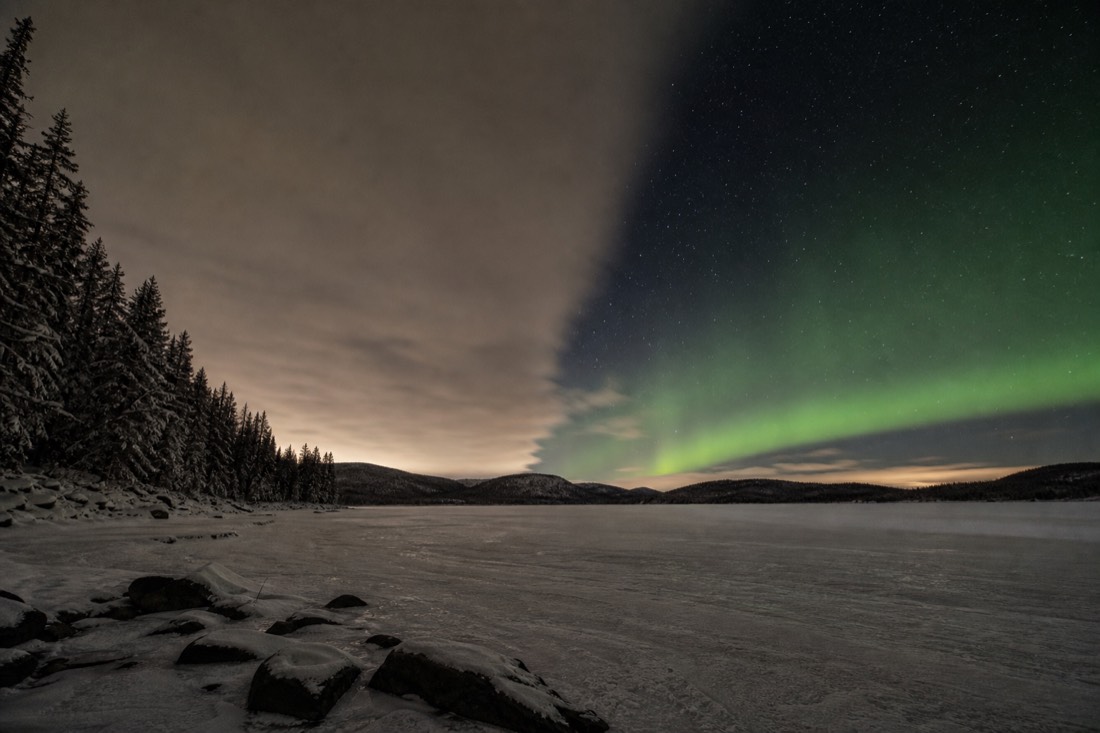
The Kp index is a global measure of geomagnetic activity on a scale of 0 to 9, and all a higher number really does is push the auroral oval further south. That matters enormously in Edmonton or Minnesota, where Kp 5 and up is roughly the entry price. Here the oval is already overhead. So the number visitors obsess over before they land is the number that changes least about their trip, and the one nobody thinks about, cloud, is the one that decides it.
I check the satellite picture before I check anything geomagnetic. On a normal night the sky over this region is not uniform: one lake sits under a grey lid while the next basin along the trail is open and full of stars. A fixed camp lives with whatever lid is above it. A van reads the same picture and goes somewhere else. Neither approach changes the aurora, which is the point people miss. The aurora is usually there. Whether anything reaches your eyes is a question about the troposphere, not the sun.
| What is happening | How much it moves your night here | Fixed camp response | Mobile hunt response |
|---|---|---|---|
| Cloud over your viewing spot | The most common decider in Yellowknife | Wait for a gap over the site | Reposition, up to three viewpoints on the flagship route |
| Geomagnetic activity (Kp) | Less than visitors expect; Kp 1 to 3 often works under the oval | Identical for both formats | Identical for both formats |
| Time of night | Peak near local midnight, roughly 10pm to 2am | Full hours on site | Some of those hours spent driving between spots |
| Moon illumination | Washes out faint displays, matters most for photography | Set by the site | Can favour a darker horizon away from town glow |
| Local light pollution | Small city, but the glow is real close in | Fixed by where the camp was built | Chosen fresh each night |
| Season window | Mid-August to early October, mid-November to early April | Identical for both formats | Identical for both formats |
Forecasting has a short useful memory, which is worth understanding before you build a plan around it. The 30-minute NOAA aurora nowcast tells you something real. The 27-day outlook tells you almost nothing about a specific Tuesday.
| Forecast horizon | What it is genuinely good for | How far to trust it |
|---|---|---|
| 30 to 60 minutes (Ovation nowcast) | Deciding whether to walk outside right now | The dependable one |
| 1 to 3 days (solar wind outlook) | A rough sense of the coming activity level | Moderate |
| 27-day recurrence outlook | Recurring patterns only | Not for choosing a night |
| Cloud forecast for the region | The factor that actually decides your night | Check this one first |
Which apps do what, and which are built for this latitude rather than Britain, I sort through in the best aurora forecast apps.
Which aurora format wins on the things that genuinely differ?
Strip out everything the two formats share, the sky, the season, the hours, the geography, and only six things actually differ: warmth on demand, response to cloud, group size, time spent in a vehicle, photo support, and how many horizons you see. Score those six against your own priorities and the choice stops being a brand argument.
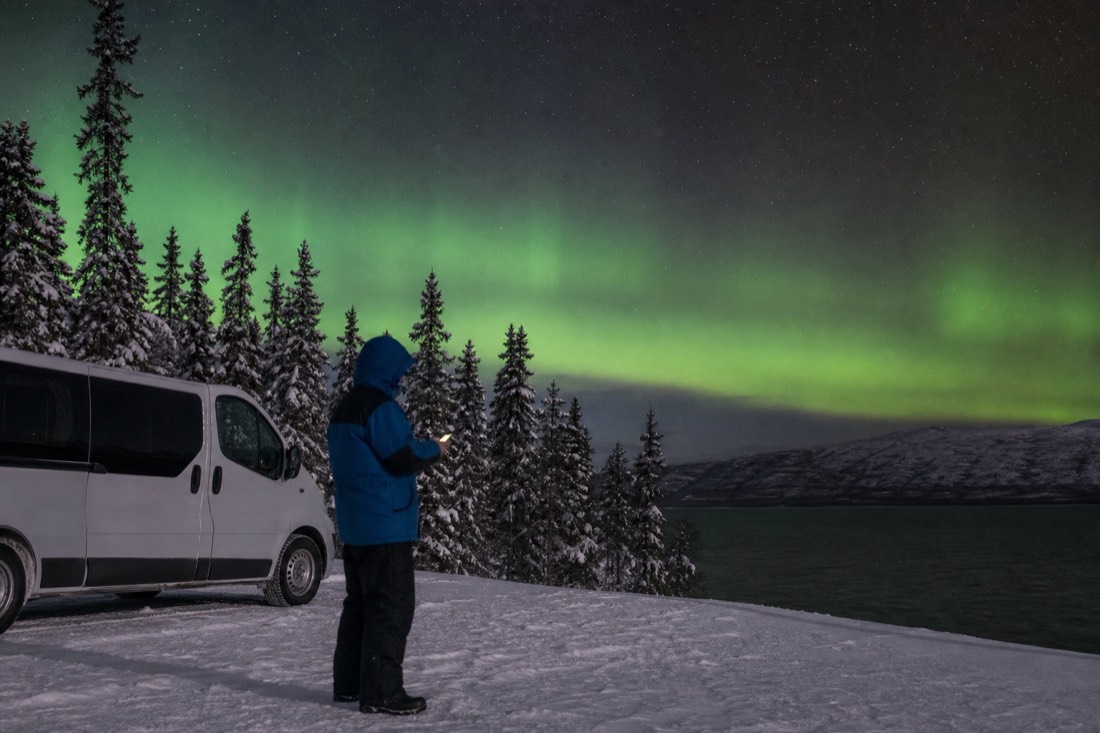
This section is my judgment rather than a spec sheet, so here is the basis for it: I have guided in Yellowknife since 2022 and taken more than a thousand travellers out under this sky, self-reported and countable only by me. What follows is how I would score the formats if a friend called and asked. I score the models, not any rival company's night, because I have not sat in someone else's teepee with a clipboard and I am not going to pretend otherwise.
| What differs | Fixed camp | Mobile hunt | Lodge with chase option |
|---|---|---|---|
| Warmth on demand | Built heated shelters, step in and out all night | Heated van, the warmth travels with the group | A real heated building, games and WiFi |
| Response to cloud | Wait for a gap over the site | Drive out from under it, three viewpoints a night | Stay warm, or take the chase option |
| Group size | Built to host large numbers at once | Max 16 on the flagship hunt | Up to 38 |
| Time in a vehicle | Transfer out and back | A working part of the night | Transfer out and back, more if you chase |
| Photo support | Varies by operator | Photographer on board, free photos included | Photographer |
| Horizons per night | One prepared foreground | Up to three, chosen for where the arc sits | One, plus whatever a chase finds |
Two of those rows carry more weight than the rest. Group size decides how the night feels at the moment the sky opens: sixteen people spread along a lakeshore is a different experience from a crowd, quieter, easier to get a tripod down in, and easier for a guide to notice that your fingers have stopped working. Horizons per night decides what you take home. One foreground photographed for four hours is lovely on the first frame and repetitive by the fortieth, which anyone working through northern lights photography in Yellowknife will recognise quickly.
The rows people overweight are warmth and vehicle time. Both formats keep you warm if you dress properly, and dressing properly is not optional in either one. If your clothing is right, four hours out is comfortable in a van or a teepee alike. If it is wrong, no amount of built infrastructure saves the night, which is why the layering question sits upstream of this whole comparison.
Can you book an aurora camp and a hunting tour on the same trip?
Yes, and on three nights or more it is what I actually suggest. Take one camp or lodge night for warmth and atmosphere, one mobile hunt for cloud insurance and the small group, and keep the third night flexible. Three nights in season carry that 98% chance, and mixing formats spends them better.
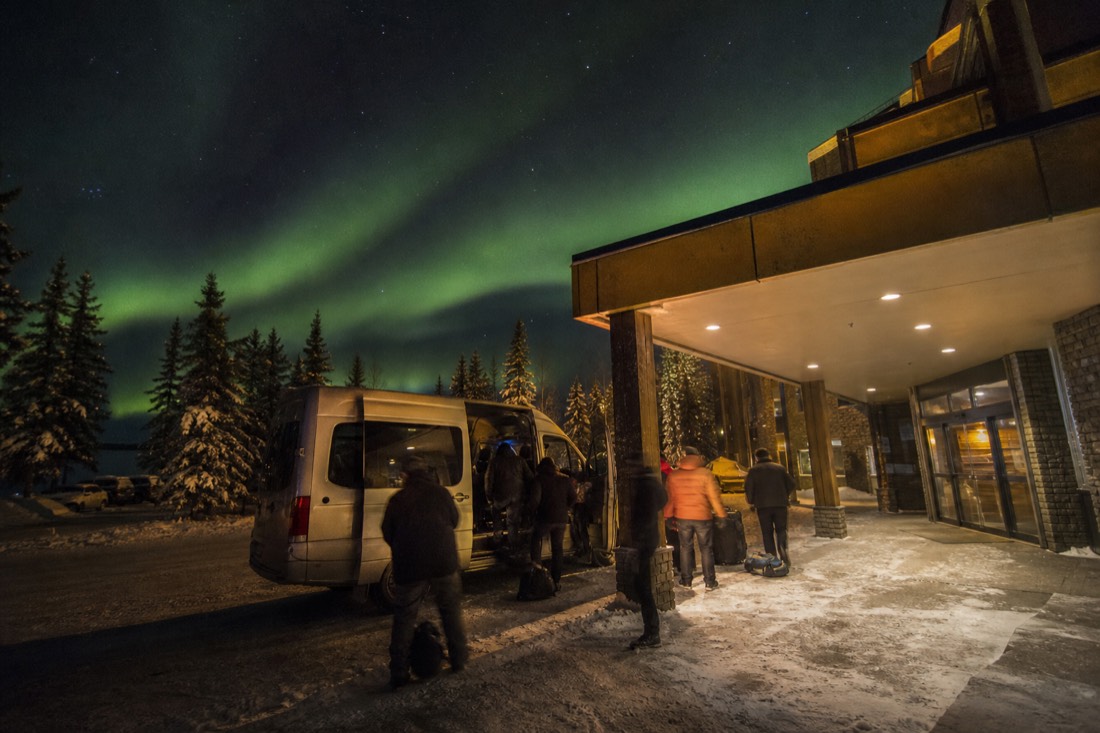
Most people arrive treating this as a single decision, then discover on night two that they wanted the other thing. Mixing solves it, and it costs nothing structurally: the formats run at the same hours on the same nights, so you are not sacrificing anything to try both. The order matters more than the split. Put the warm fixed night first, when you are tired from the flight and still learning what your gloves do, and save the hunt for a night you can read the sky ahead of.
| Night | What to book | Why that order |
|---|---|---|
| Night 1, arrival day | Camp or lodge, whichever suits the group | Jet lag, new gear and deep cold all land at once; a warm base is the kinder introduction |
| Night 2 | Mobile hunt | Small group, three viewpoints, photographer and free photos on the flagship |
| Night 3 | Held flexible where possible, backed by the better forecast | By then the cloud picture is inside its useful range and you can commit to the better sky |
| Longer stay, 4 nights or more | Add the two-night cabin | You sleep where the show happens, with transfers included |
The flexible third night comes with a real caveat, so take it straight. In peak weeks, holding a night open is a good way to find nothing available, and the small-capacity tours go first. Free cancellation up to 24 hours out on the flagship hunt and the lodge tour gives you the workable version instead: book all three nights now, then release one if the forecast reshapes your plan. That is the shape most of my repeat guests settle into, and it is the backbone of the plan in the Yellowknife aurora itinerary.
One more note for autumn visitors. Between mid-August and early October the lakes are still open water, the temperatures are civil, and reflections do things no winter night can offer, but true darkness is short at the start of that window. Mixing formats matters more then, because you have fewer usable hours per night to work with.
What do Aurora Village reviews tell you about a Yellowknife aurora night?
Mostly they record the weather on somebody else's night. Aurora ratings swing with cloud, and no camp or van controls that. Since we do not sell Aurora Village, here is the straight version: read reviews of any aurora operator for the things a company can actually control, then judge the two formats on what they do when the sky turns.
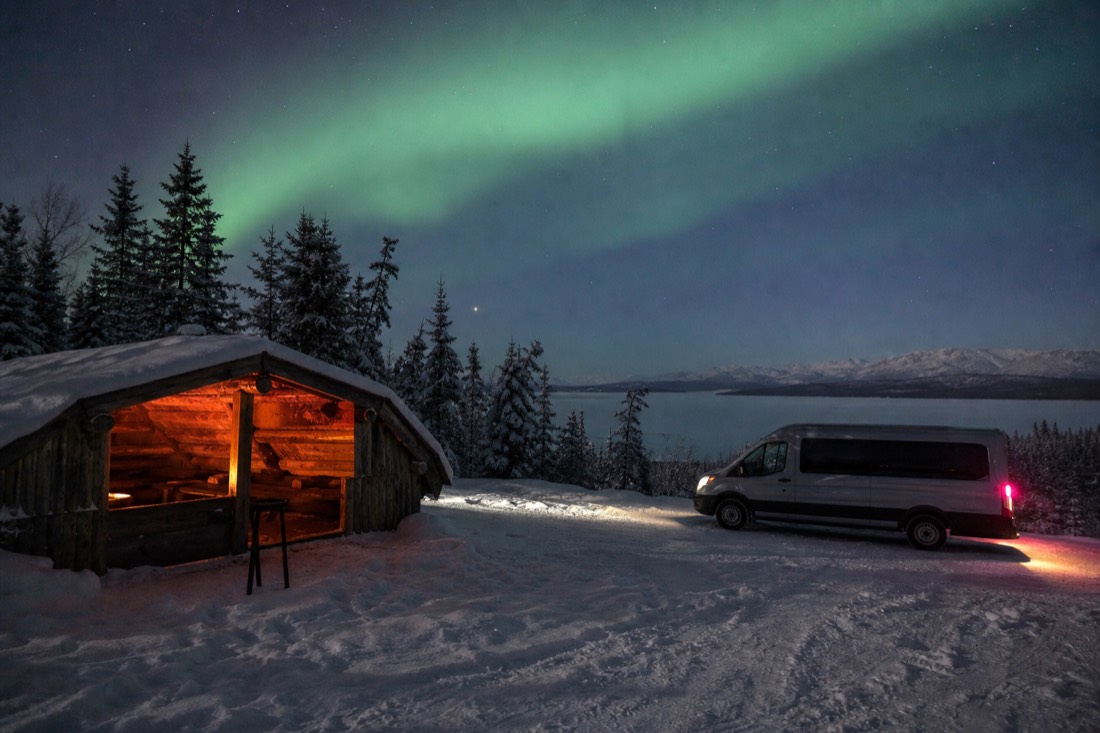
Two guests can sit in the same teepee, on the same bench, with the same guide and the same hot chocolate, and leave one-star and five-star reviews depending on what the sky did between 11pm and 1am. That is true of every aurora product in this town, ours included. So when you scan reviews, skim past the sky and look for the operator's actual work: did pickup arrive when it said it would, was the warm space genuinely warm, how many people shared the site, did anyone help when a camera refused to focus in the dark, and did the guides keep the night interesting through a quiet hour. I cannot quote you numbers for a camp I do not sell, and I am not going to invent any. Go read them at the source, then come back to the format question, because the format is the part that changes your odds.
Underneath the review-hunting sit five real questions: how you get out of town and back at 1am, how many strangers you share the view with, what happens if cloud parks overhead, whether you go home with a picture of yourself under the lights, and whether you can cancel. Our own listings answer those with verified numbers. The flagship hunt holds 4.8 across 399 Viator reviews with hotel pickup, a cap of 16, four hours, three viewpoints and free photos from a photographer who comes along. The lodge tour sits at 4.7 across 130, with a heated building near Madeline Lake and a chase option in reserve. A fixed camp answers the warmth and atmosphere questions best by design, since a built site exists to host far more people than a van seats.
For photographers the split is sharper than most reviews let on. At one prepared site you work a single foreground all night, which is lovely once and repetitive by the third hour. On a hunt you get several horizons, chosen for the arc's position, and someone whose job is your exposure settings rather than yours. The rest comes back to sky. Cloud is the layer that decides most Yellowknife nights, so before you pick a style, spend ten minutes on reading the Yellowknife aurora forecast. It reorders the whole decision.
One last piece of guide's honesty: whichever style wins you over, decide before you land. Peak-season nights sell out across the board in this town, camps and hunts alike. Line your dates up against the best time to see the northern lights in Yellowknife, and if you are still wondering whether you need a tour at all, I answer that with a straight face in do you need a tour to see the northern lights in Yellowknife.